Raipur (Chhattisgarh): Ask first-year interior design students what they expected from the course, and most will say drawing. What they learn soon enough is that the job has as much to do with budgets, site conditions, materials and difficult clients as it does with how a room looks.
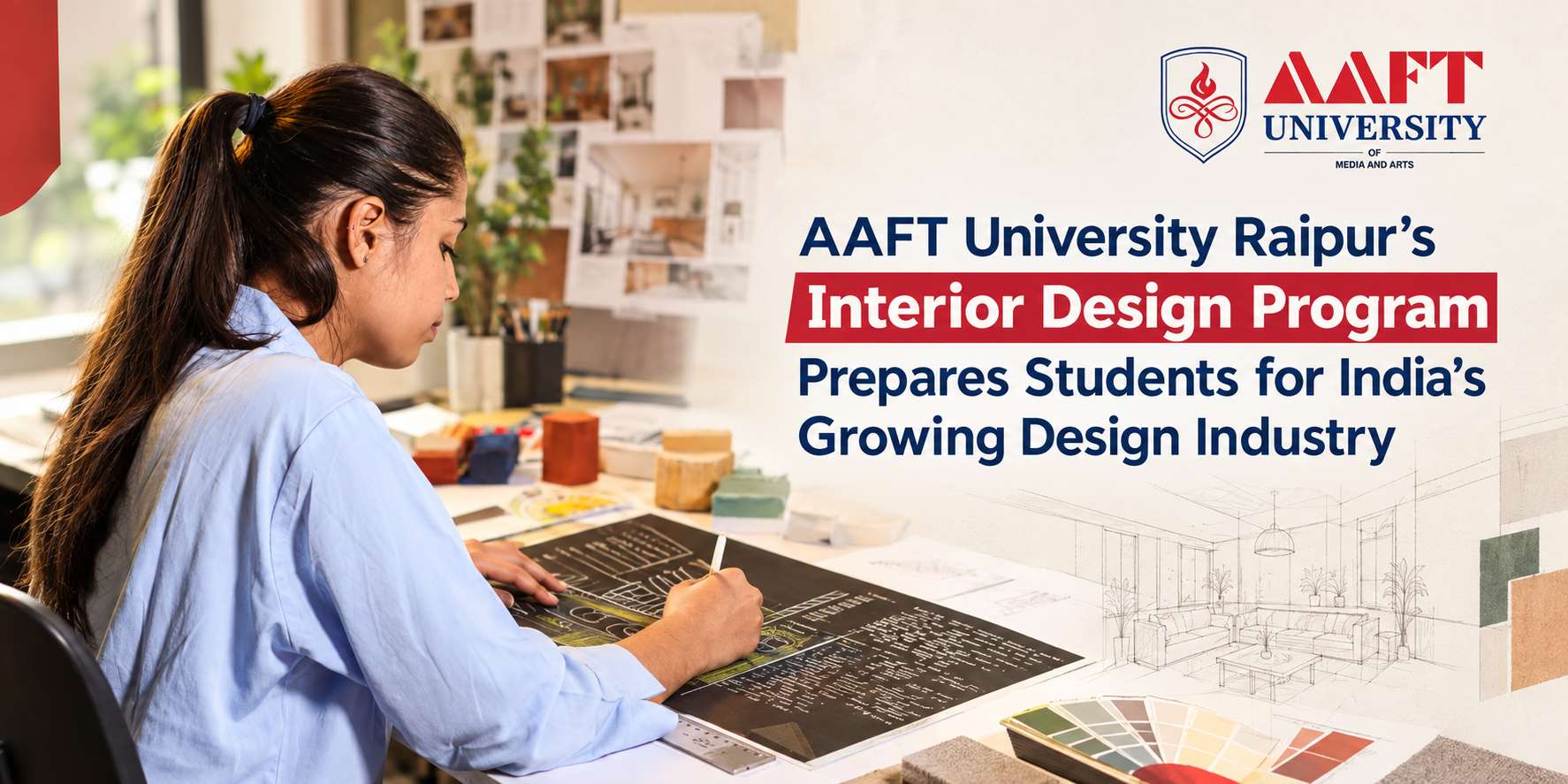
The university's School of Interior Design offers a Diploma, B.Sc., B.Des. (Honours) and M.Des. in Interior Design, pairing studio work and site visits with mentoring from practising designers. Admissions for the 2026 batch are now open.
That gap between the drawing board and the site is what AAFT University Raipur has built its School of Interior Design around. Students work in design studios, model-making labs and digital visualisation suites from their first semester, and a large share of their degree is spent on site visits, live briefs and market surveys rather than in lecture halls. The school is guided by Industry Dean Sunita Kohli, the Padma Shri awardee known for her restoration and interior work at Rashtrapati Bhavan and Hyderabad House in New Delhi.
For students searching for an interior design college in Raipur, or an interior design course in Chhattisgarh that ends with a working portfolio rather than just a certificate, the university has opened admissions for 2026.
Interior Design Programs at AAFT University, Raipur
The school runs four programs, so students can enter at the level that suits their background and goals:
- Diploma in Interior Design: a shorter, skills-first route for students who want to start working sooner, covering space planning, colour, lighting, materials, furniture and Vastu.
- B.Sc. (Interior Design): an undergraduate degree for students who want a strong technical and design foundation before entering practice.
- B.Des. (Honours) (Interior Design): a four-year, 160-credit program with advanced studio practice, an internship, a research track and a final dissertation. The next batch begins in August 2026.
- M.Des. in Interior Design: a postgraduate program for graduates who want to specialise, step into senior design roles or move into teaching.
What Students Learn, Year by Year
Take the B.Des. (Honours) program as an example. The first year is about fundamentals: basic design, the history of interiors, building materials and construction, and a first room-design project alongside an introduction to AutoCAD.
By the second and third years, the projects get bigger and more specific. Students design residential spaces, cafés, retail stores, restaurants and showrooms, and move on to 3 and 4 BHK homes, luxury hotel rooms and office floors. Vastu, furniture design, SketchUp, estimate and costing, building services and design execution drawings are taught alongside, and the sixth semester includes an industry internship.
The final year pushes into areas where the industry is heading such as energy-efficient and sustainable interiors, biophilic design, interior landscaping, and healthcare spaces such as clinics and multi-speciality hospitals. It closes with project management and a dissertation. Students work on AutoCAD, SketchUp and 3ds Max throughout, and use 3D printers for digital fabrication and prototyping.
Mentored by Padma Shri Sunita Kohli and practising faculty members
Sunita Kohli set up her interior design practice in New Delhi in 1971. Over five decades she has restored and designed interiors for some of the country's most important buildings, including Rashtrapati Bhavan, the Parliament House colonnade, the Prime Minister's Office and Hyderabad House. She was awarded the Padma Shri in 1992 and has lectured at institutions such as Harvard University's Kennedy School of Government.
As Industry Dean of the AAFT School of Interior Design, she shapes the school's design direction and mentors students through masterclasses, bringing a rare perspective on heritage, craftsmanship and restoration into the classroom.
On campus, the school is led by School Coordinator Devesh Keshwani, with Assistant Professors Naina Agrawal and Nuria Niyaz teaching across the programs. Architects, interior designers and product specialists also hold regular sessions with students, so what is taught stays close to how studios work today.
Studios, Site Visits and Live Projects
Most of the learning happens with a pencil, a mouse or a material sample in hand. Students prepare technical drawings, 2D and 3D drawings on sheets and software, material boards, and furniture designs of their own, and take on space makeovers as part of their coursework. Every week, the school runs mind-mapping sessions where students brainstorm and debate design strategies in groups.
Outside the studio, students visit sites, workshops and design expos, including trips such as a visit to Expo IMAARA, and carry out market surveys on materials and pricing. Assessment follows the same practical logic: students are graded on portfolios, concept and mood boards, presentations and vivas, site visit reports and industry project submissions, not just written exams.
Why India Needs More Trained Interior Designers?
India's cities are building more homes, offices, malls and hotels than ever, and the people paying for these spaces are asking for more from them. Urban homebuyers now hire designers for full-home projects instead of piecemeal decoration. Restaurant chains, retail brands and hotel groups compete on the strength of their interiors as much as on their products. Corporate offices, co-working spaces and hospitals have added to that demand.
For graduates, this means a much wider set of sectors to work in than the field offered a decade ago, and employers who expect new designers to handle drawings, costing and site coordination from their first month on the job.
What Jobs Can You Get After an Interior Design Course?
Graduates of AAFT University Raipur's interior design programs can work with residential and commercial design studios, retail and hospitality design firms, furniture and product companies, and real estate developers. Because the AAFT group has its roots in film and television, students also have an unusual route into set and production design. M.Des. graduates often move into specialised consulting, design leadership or academia.
The Data below shows common roles and indicative salaries in India:
Junior Interior Designer / Design Assistant: Starting salary: ₹2.5–4.5 lakhs per year. With experience: ₹5–8 lakhs per year.
Residential Interior Designer: Starting salary: ₹3–4.5 lakhs per year. With experience: Up to ₹8 lakhs per year.
Commercial & Retail Interior Designer: Starting salary: ₹2.5–4 lakhs per year. With experience: ₹5–9 lakhs per year.
3D Visualiser: Starting salary: ₹1.5–3 lakhs per year. With experience: ₹5–7 lakhs per year.
Furniture Designer: Starting salary: ₹2.5–4 lakhs per year. With experience: ₹4–10 lakhs per year.
Exhibition & Event Space Designer: Starting salary: Around ₹2.4 lakh per year. With experience: Up to ₹9 lakhs per year.
Set / Production Designer: Starting salary: Around ₹3.9 lakh per year on average. With experience: Project-based, with earnings growing with credits.
Senior Designer / Design Head: Starting salary: Not specified. With experience: ₹9–25 lakh and above per year.
Freelance Designer / Studio Owner: Starting salary: Project-based. With experience: ₹50,000–₹2 lakhs per month.
AAFT University's placement tie-ups for interior design include DLF, Livspace, Godrej, Fabindia, Sleek and Decode Interiors.
In Their Own Words
Speaking about the university's approach to design and media education, Sandeep Marwah, Chancellor of AAFT, said, "Industry integration, global exposure, and practical training define what makes an institute world-class today. From Day 1, our students learn by doing. A world-class institute must act as both a finishing school and a launchpad, one that inspires innovation, adapts rapidly to change, and connects students to real-world challenges and opportunities."
About AAFT University, Raipur
AAFT University of Media and Arts, Raipur is a UGC-approved private university in Chhattisgarh and part of the AAFT group, founded in 1993 by Dr. Sandeep Marwah, who also founded Marwah Studios at Noida Film City. Its 27-acre campus at Village Manth, Kharora, houses 15 schools across cinema, journalism and mass communication, animation, fashion design, interior design, fine arts, music, photography, hospitality, management, law and wellness. The university's teaching model combines classroom learning with studio practice, live projects and mentoring from Industry Deans drawn from each field.
For Admission and Media Inquiries, Contact:
AAFT University, Raipur
Admission Office: GF-18, Ground Floor, Shyam Plaza, Pandri, Raipur, Chhattisgarh - 492001
University Campus: Village Manth, Kharora, District Raipur, Chhattisgarh - 493225
Phone: +91-9109112078 / +91-8064057209
Website: www.aaft.edu.in